
- info@sosittrading.com
- 043240050 | 0509694734
- Shop No-S12 W02 - Warsan First - Russia Cluster - Dubai - UAE

Qualities to Consider When Selecting a Rental Printer
- April 1, 2026
Introduction: The Significance of Feature Selection in Rentals
The benefits of renting a printer include flexibility, reduced ownership costs, and the capacity to reduce maintenance expenses. However, the calibre of the printer being hired out can affect the calibre of the printer rental service. This article is intended for decision-makers and office managers who want to rent a printer that can meet the demands of the workplace. It talks about the different characteristics of a printer and how important it is to select the correct one by being aware of the consequences of selecting the incorrect one and the range of possibilities at the decision maker's disposal.
Prior to selecting the features, comprehend the printer's use case.
The decision maker and the office manager must first comprehend the office printer's use case before delving into the printer's features and the significance of selecting the best one. This can be accomplished by knowing how many pages are printed each month, how frequently the scanner is used, etc. This would improve comprehension of the printer's features and the significance of selecting the appropriate one.
Volume Capacity and Duty Cycle
The printer's duty cycle is one of the most crucial aspects of a printer rental business. This is the quantity of pages that the printer can print per month without sacrificing print quality. If the office's use case exceeds the printer's duty cycle and the rental printer has a low duty cycle, the printer will sustain more damage than usual, necessitating the replacement of several parts and shortening its lifespan.
Response Time and Print Speed
In shared offices, print speed in terms of pages per minute and response time to first page out are important. If several jobs are building up, an unresponsive printer will annoy everyone. Daily efficiency is affected by these criteria. These factors are important, even if they are small. You need to test example print jobs to compare printers.
Capability of Colour vs. Monochrome
Do you need to be satisfied with monochrome printing, or will you need to produce colour documents? While colour printers are more expensive to run and maintain, they might be necessary for client documents, marketing materials, or signs. To avoid running into an uncontrolled cost situation, if you decide to rent a colour printer, be sure that colour usage is controllable by the user or quota.
Support for Scanning, Copying, and Duplex Workflow
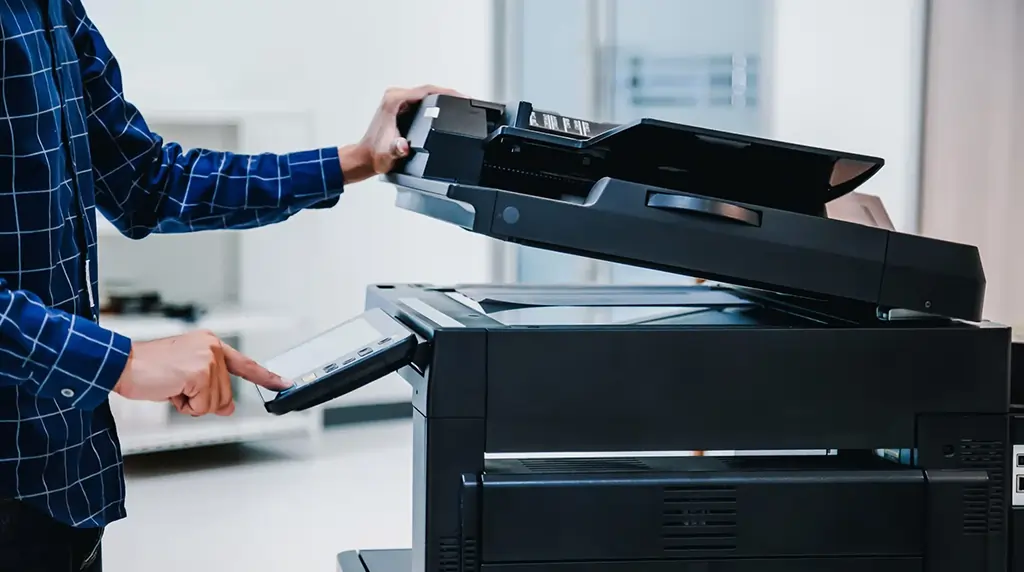
These days, scanning, duplicating, and internal distribution are part of most office activities. A printer that can transmit scans to email, network folders, or cloud storage in addition to having a strong automated document feeder (ADF) and duplex scanning is significantly more valuable than one that just prints. These scan characteristics should be considered non-negotiable if your documents are multi-page or you scan numerous forms.
Interoperability and Connectivity
Both wired Ethernet and wireless connectivity are required for a rental printer. Additionally, the rental printer needs to function with your phones, tablets, laptops, and workstations. The rental printer needs to have these features if your company employs cloud print solutions, managed print servers, or network authentication.
Compliance and Security Features
In a shared setting, security is particularly crucial. User authentication, secure print release (jobs are only printed when the authorised user is present), encrypted data transmission, logging, and detachable job storage should all be features of a rental printer. Ask whether the device satisfies compliance requirements, such as data retention regulations or audit logs, if your company deals with sensitive or regulated data.
Handling and Finishing Paper
A printer that is used on a regular basis should have sufficient finishing options and paper handling capabilities. It would be possible to handle different sizes or types of paper without having to switch between them if a printer had multiple paper trays. If reports or presentations need to be printed, the output tray, sorting, stapling, punching, and booklet finishing are crucial. One would have to perform such things by hand if one had such facilities.
Consumable Yield and Replacement Policy
Learn how the supplier handles consumables during the rental period. Ask if the price covers cartridges, toner and drums or if each item is billed separately. Request the replacement rule plus the stated yield, which is the page count each component is expected to deliver. Select components that carry a high yield so that staff exchange them less often, and the flow of work stays steady. Insist that the contract states the supplier will track levels but also ship new stock before the old one empties.
Assistance and service levels
Study the service level agreement - it must state the maximum time that will pass between your fault report and the technician's arrival. Check if the supplier delivers on-site visits, keeps spare parts in stock, sends automatic alerts and watches the device from a distance. A low rental fee loses value if the machine stops often, whereas preventive care that spots worn parts early keeps pages printing.
Flexibility in contracts or options for upgrades
Confirm that the written terms allow a switch to a different model when requirements shift. Ask if you may return the printer ahead of schedule or move to a faster or larger unit without heavy fees. Such clauses protect you from keeping hardware that no longer matches the scale of the operation.
Updates for software, firmware and warranties
Demand proof that patches, firmware revisions, and warranty coverage stay active for the whole rental.
Interface, Training, and Usability
Frustration is decreased by a printer with a robust user interface. Staff adoption of the device is accelerated by touchscreens, easy menus, shortcut keys for routine operations, and labelled workflows. The printer's usability increases productivity if a large number of employees utilise it.
Usage analytics, reporting, and monitoring
Good rental printers offer use reporting, including error logs, alarms, toner usage, and the number of pages printed by each department. These analytics help with operational intelligence, departmental budgeting, and cost recovery. Find out if access to reporting dashboards or logs is included in the rental.
Power Efficiency, Environmental Features, and Footprint
This factor, though not necessarily a priority, should be considered, especially if the device has features that allow it to go into standby mode, thus cutting costs. The footprint, too, should be considered, especially if your office has limited space.
Reliability and Proven Track Record
You should be able to get some references, reliability, or uptime guarantee from your provider. A reliable provider should be able to offer products that have been proven reliable, with mean time between failures (MTBF) data. Devices that have been used in similar working conditions should give you an idea of how reliable your printer will be in your working environment.
Summary of Feature Priorities
In selecting a rental printer, there are several factors that should be considered first, such as matching your duty cycle, support and service, security, scanning and finishing, consumables, connectivity, and finally, flexibility in upgrades. If a rental printer meets all these requirements, then there is no question that it will be more valuable than one selected purely on price.